

In the desert, the guest is welcomed before arriving: with water, with shade, with a carpet laid on the sand.
SIYAK-U SİBAK - ROSHN URBAN LANDMARK
#competition, #roshn, #musahama, #ksa, #urbanlandmark, #hospitality, #gfrc, #passivecooling, #publicspace, #desert
Information
SIYAK-U SİBAK - ROSHN URBAN LANDMARK
SIYAQ&SIBAQ - THE ROOTS
In Quranic hermeneutics, siyaq and sibaq — the context that follows and the context that precedes — establish that no word, no verse, carries its full meaning in isolation. Meaning is relational. A word is defined by what came before it and what will come after. To extract it from its sentence is to misread it entirely.
Architecture has long forgotten this. Urban interventions are dropped into cities like exclamation marks — self-contained, self-referential, indifferent to the sentence they interrupt. This proposal begins from the opposite premise: every element exists as part of a larger utterance. It has a before. It has an after. It is never the whole story — only the word
that makes the rest of the sentence possible. This proposal operates on the same principle — simultaneously, at three scales.
At the scale of the units: four GFRC modules, each face geometrically calibrated so that any surface can meet any other at any orientation — without gap, without seam, without hierarchy.
No panel is a beginning. No panel is an end. Each one is always the middle of something.
At the scale of the site: the tower does not arrive alone. It arrives already knowing what will surround it. The development plan exists before the first stone is placed — the future streets, the courtyards, the thresholds are already drawn. The totem is planted at the heart of what will become a city, carrying within its position the full weight of that future. It is a
word placed deliberately in a sentence still being written.
At the scale of meaning: these panels have no correct orientation. Stood vertically, they mark and enclose. Laid horizontally, they ground and shelter. Rotated, flipped, combined — the surface continues regardless. There is no top. There is no front. Meaning, like the
desert itself, does not depend on which way you are facing.
Saudi hospitality begins before the guest arrives: the coffee is already warming, the carpet already spread on the sand. The Roots, designed for ROSHN's MUSAHAMA Iconic Urban Landmarks competition, proposes a landmark that behaves the same way — not an object that announces a city, but a host that receives it.
Its logic comes from siyaq and sibaq, the context that precedes and the context that follows: in Quranic hermeneutics no word carries its meaning alone, and here no landmark does either. The project is written as a sequence. In the empty desert, before ROSHN has laid a single foundation, it stands as a totem heralding the life to come, and it harvests water from the night air. When the city arrives, the same stone keeps public life cool with shade, seats and moist air. When it travels abroad, it lies down as a carpet: four GFRC modules cast with the soils of each new place, carrying the Saudi custom of gathering on open ground rather than a symbol of it.
Client
ROSHN — PIF MUSAHAMA Design Competition
Location
KSA
Size
Awards
Shortlisted
Program
Urban Landmark, Public Space, Passive Cooling and Water Harvesting Tower, Urban Furniture, Modular Kit of Parts
Status
Competition Entry
Collaborators
Sacit Arda KARAATLI
Lebriz ATAN KARAATLI
Ehab Al Amri (Urban Planner)
Before the City


Bashir — The Herald
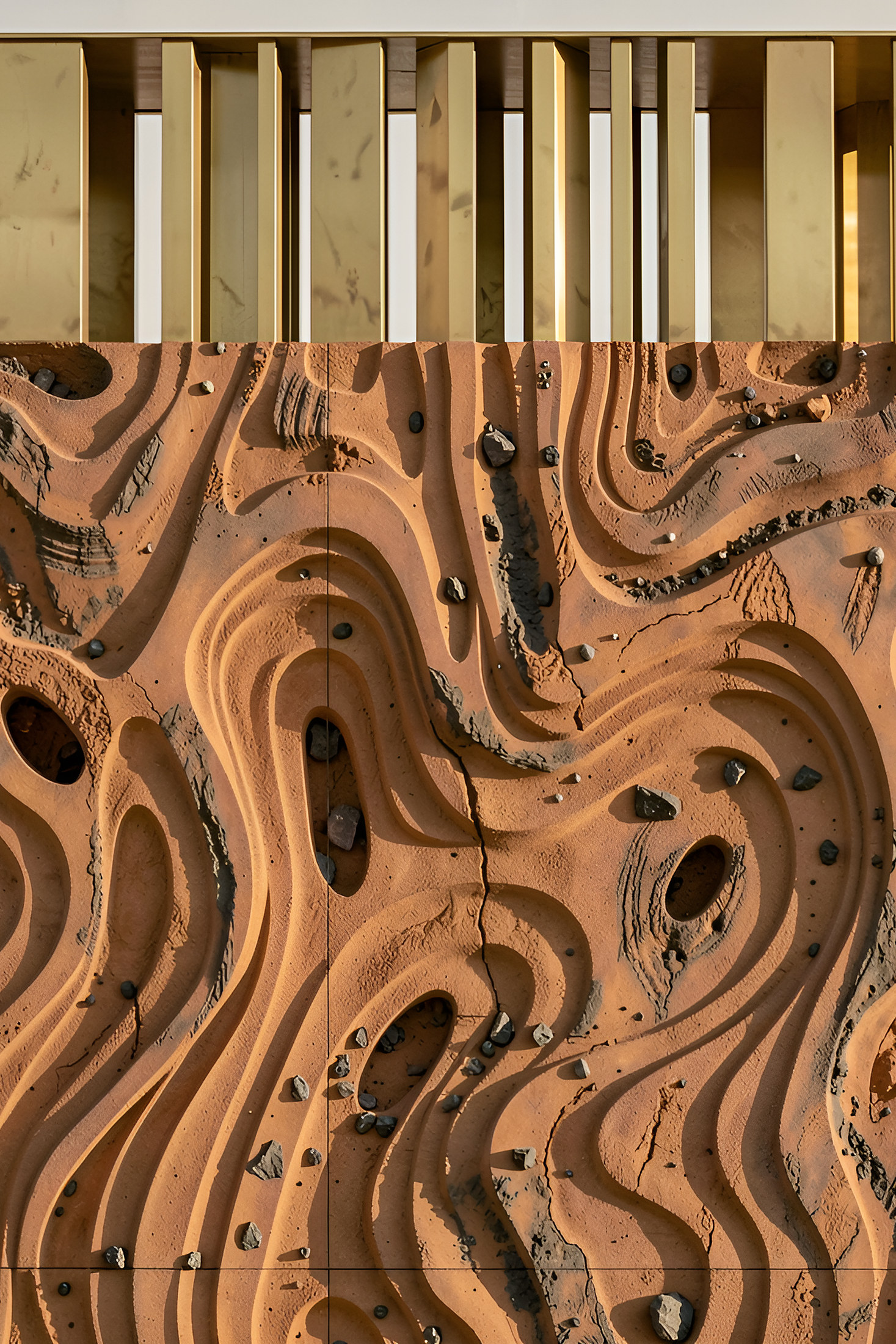
Bashir — the one who brings good news. Long before ROSHN pours a foundation, a single tower is planted in the open desert: solitary, vertical, six metres of contoured stone under a brass crown. It is not a placeholder for the city to come. It is the host's first gesture, the sign on the horizon that life is on its way.
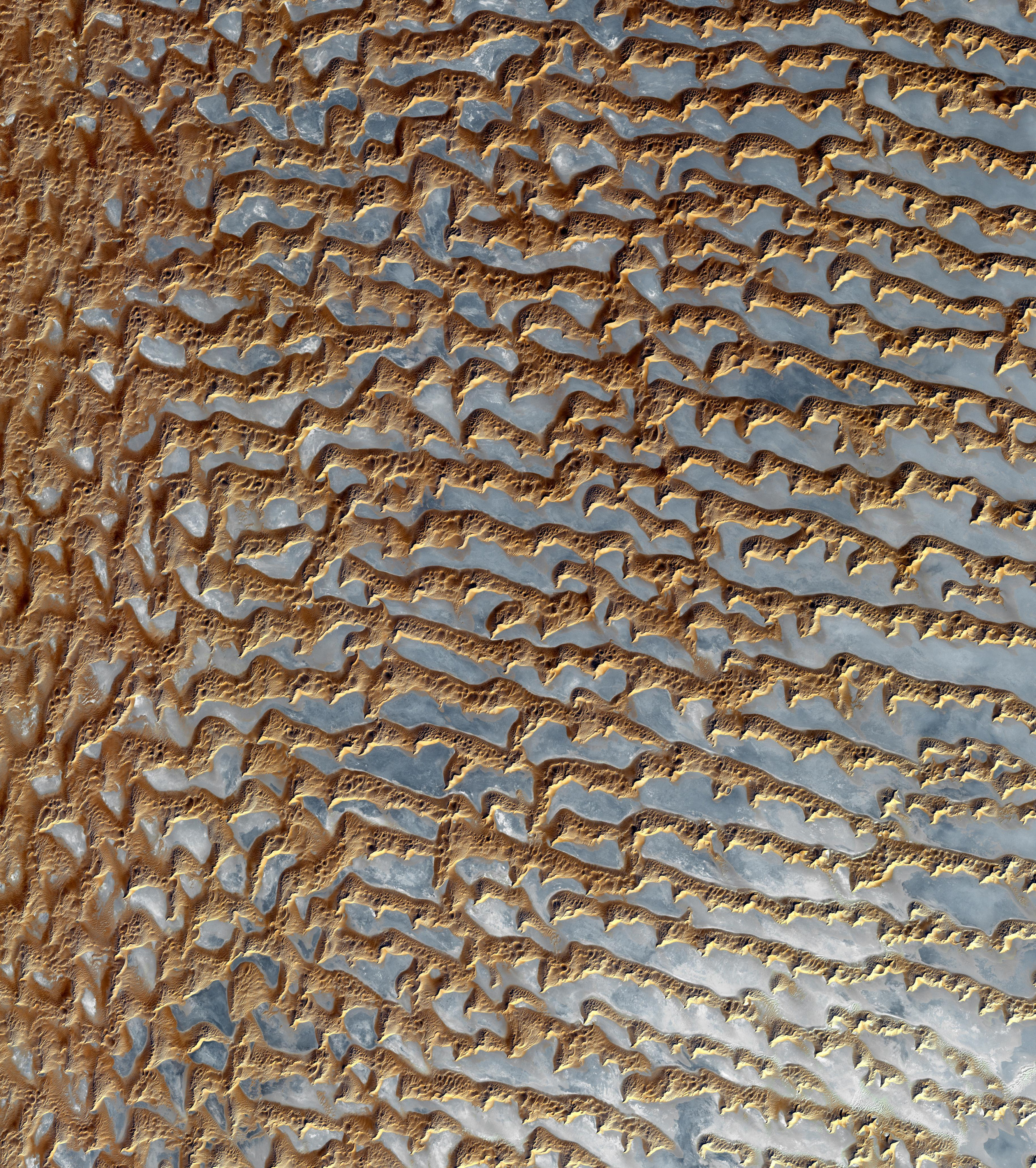
Its surface is a dune held still. Stepped contours, written by the wind and pressed into GFRC, catch the low sun at dawn and dusk; from afar it reads as part of the landscape, up close as an invitation to come nearer.
The Sweating Stone. The inner face of every panel is lined with MOF, a metal-organic framework that captures moisture from desert air even at very low humidity. By day the brass crown absorbs solar heat and drives a thermal updraft through the hollow core: fresh air is drawn in at the base, crosses the moist inner faces and takes up the water captured overnight. The vapour condenses on the cooler lower panels and trickles into a small brass basin at the foot of the tower.
No electricity, no moving parts, nothing to maintain. Birds find the basin first, then grasses take root around it; the desert begins to gather around the stone long before the streets do.
Tower, sentinel, threshold, wadi: the same stone can stand alone or gather into walls and grounds, ready for the city it is waiting for.
Before anyone lives here, it already offers water.


Four Moulds, One Ground
The whole system is cast from four silicone moulds. Each 6 × 3 m GFRC module carries its own topography, and its contour lines leave and enter every edge at identical points, so any panel can meet any other, in any orientation, without a seam.
This is what lets the totem change roles as its context changes. Stood upright, the modules become towers, stelae and walls; laid down, they become benches, platforms and planters. Nothing in the module changes — only the sentence it is placed in.


When the city arrives, the stone stays — and keeps the street cool.

Shade for Public Life
As ROSHN's neighbourhoods fill in around it, the tower does not retire into ornament. It keeps doing what it did in the empty desert — cooling the air, offering water — now for a square full of people. Around it, the same modules unfold into the furniture of daily life: shaded thresholds, walls thick enough to hold shadow, planters, and seats still cool to the touch at noon.
Someone rests in the shade of the wall; someone fills a cup at the basin; children run along the contours. The landmark becomes the place where the neighbourhood pauses — public life kept cool by a stone that was there first.


Every Saudi family knows the ritual: drive out into the open desert, cut the engine, spread a carpet on the sand and sit together in that immensity. Hospitality here is not a building but a ground offered to others.
When The Roots travels abroad, it does not stand up as a monument or a souvenir of Arabian form. It lies down. The four modules spread across a foreign square as a carpet of gathering — low enough to sit on, wide enough to get lost in. Each time, they are cast in GFRC with the ground of the place they arrive in: local sands, soils and stones, laid face-down in the same four moulds and washed open after demoulding.
The pattern stays Saudi; the ground becomes local. Four moulds, infinite grounds — a culture carried not as a symbol, but as a way of sitting together.
Abroad, it does not bring an image of Arabia. It lays down a carpet.


Related Projects
Once, to arrive by train was to arrive at the heart of the city.
A mineral plate where the ground becomes roof


İstanbul (HQ)
Caferağa Mahallesi 34347 | Moda-Kadıköy
info@kaat.co + T: +90 216 330 55 84
Barcelona
Carrer de Fluvià, Sant Martí 08019 | Barcelona
info@kaat.co + T: +34 610 17 94 47
KAAT KENTSEL VE MİMARİ TASARIM DANIŞMANLIK HİZMETLERİ LİMİTED ŞİRKETİ
DUNS : 751139382
Latest
13/07/26
Our project has been honored with the Equivalent 1st Prize in the Bodrum Değirmenburnu Historical Windmills Competition, celebrating our modern and sustainable approach to cultural heritage.
We are deeply gratified that our design, aimed at revitalizing this iconic landmark without turning the area into a theme park - in the city’s collective memory, has been highly acclaimed.
Congratulations to our entire team for this outstanding achievement.
